

A Sea Change at Sardis Chapel By Jeff McGuiness
Reposted from the Talbot Spy on behalf of Jeff McGuiness
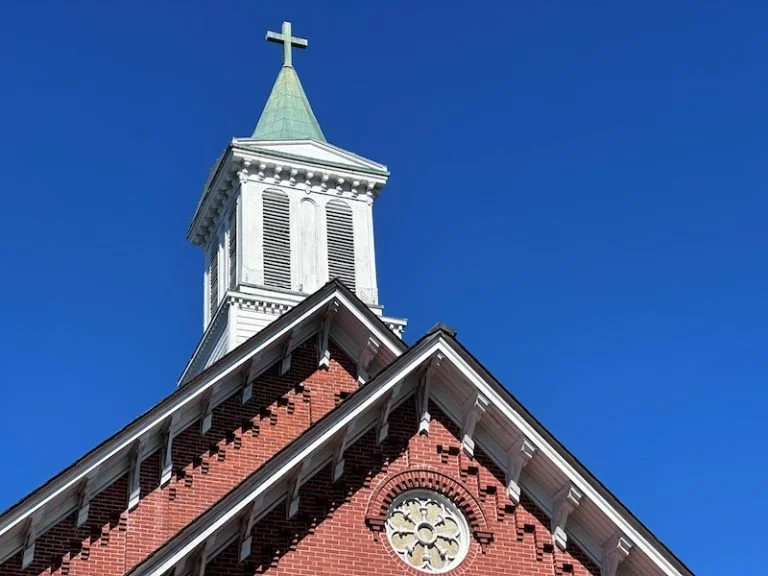
St Luke’s Steeple
Years from now, when Talbot Countians recall how they marked America’s 250th birthday, I suspect one event in St. Michaels will stand apart.
On Sunday, July 5, 2026, worshippers will gather at St. Luke’s Methodist Church, whose cornerstone still bears the name “Sardis Chapel.” The occasion will quietly embody one of the Declaration of Independence’s most enduring promises: that all people are created equal.
When Frederick Douglass lived in St. Michaels as an enslaved teenager, Sardis Chapel was the town’s principal Methodist church. In his autobiographies, Douglass recalled attending Methodist meetings and hearing “the law and gospel” from St. Michaels’ pulpit.
The connections run deep. Douglass’s enslaver, Thomas Auld, served as a trustee of Sardis Chapel. Auld’s gravestone can be found in nearby Olivet Cemetery maintained by St. Luke’s, beside that of his first wife, Lucretia Anthony Auld. Lucretia’s father, Aaron Anthony, was chief overseer of the Lloyd plantation where Douglass spent part of his early childhood. Unlike many around her, Lucretia showed the six-year-old boy kindness, tending wounds and easing hunger. Douglass never forgot it. Since Anthony is widely believed to have been Douglass’s father, Lucretia may well have been his half-sister.
In 1877, Frederick Douglass returned to St. Michaels not as the enslaved teenager who had once known its streets, but as U.S. Marshal for the District of Columbia. At the Dodson House at the corner of Cherry and Locust Streets, he came to the bedside of Thomas Auld who was nearing death. Tears filled both their eyes as they spoke candidly about the years between them—the end of slavery, the transformation of the nation, and the remarkable changes that had carried them from master and slave to two aging men reflecting on a shared past.
As a young man, Douglass moved between Talbot County and Baltimore’s Fells Point. In Baltimore, he learned to read and write under the instruction of Sophia Kemp Auld, Hugh Auld’s wife and Thomas Auld’s sister-in-law. A devout Methodist who opposed slavery, Sophia grew up in St. Michaels in the yellow house at the corner of Mulberry Street and St. Michaels Square, only steps from where Sardis Chapel once stood.
Literacy was rare in rural Maryland in the early nineteenth century. Douglass’s intelligence, eloquence, and independence drew attention. “Among the slaves, I was a bad sheep,” he later wrote. “I hated slavery, slaveholders, and all pertaining to them.”
His determination to improve the lot of his peers led him to organize a Sabbath school for African Americans at the home of free Black resident James Mitchell on West Chestnut Street. The effort ended abruptly when a mob led by Thomas Auld and St. Luke’s member Garretson West stormed the gathering with clubs, scattering students whose offense was learning to read. West, too, rests in Olivet Cemetery.
Now imagine Frederick Douglass returning to St. Michaels on July 5, 2026.
The date carries special meaning. On July 5, 1852, Douglass delivered his celebrated address, What to the Slave Is the Fourth of July, challenging a nation that proclaimed liberty while tolerating bondage.
Entering St. Luke’s that morning, he would find Rev. Elmer N. Davis in the pulpit. Douglass would see the first African American pastor to lead the congregation once known as Sardis Chapel. Raised in Wicomico County, Rev. Davis traces his ancestry to people enslaved on Maryland’s Eastern Shore.
That moment will reflect a long journey within both Methodism and the nation itself—from segregated worship and separate churches toward shared leadership and broader inclusion.
During his life, Douglass never abandoned faith in the principles of the Declaration. “The principles contained in that instrument are saving principles,” he wrote. “Stand by those principles, be true to them on all occasions, in all places, against all foes, and at whatever cost.”
Seated in St. Luke’s nearly 250 years after the Declaration was signed and listening to Rev. Davis’s message, what verdict would Frederick Douglass render on America’s progress toward those ideals? On that Sunday morning in St. Michaels, it will be difficult not to ask ourselves the same question.
St. Luke’s special service led by Rev. Davis commemorating the Declaration and the role played by Frederick Douglass in advocating its ideals will be held at 9:00 a.m. on Sunday, July 5, 2026, at 304 S. Talbot Street. All are warmly welcome to join the journey. The Sunday service will be preceded by screenings of Bear Me Into Freedom: Frederick Douglass and the Struggle for America’s Promise at St Luke’s beginning at 3:00 p.m. on Wednesday, July 1. Additional information can be found here: https://www.stlukesstmichaels.org/ .
Jeff McGuiness is a member of the Bear Me Into Freedom Collaborative and author of the photobook Bear Me Into Freedom: The Talbot County of Frederick Douglass.